Flaryx · Neron’s drone brand
Off the screen.
At Neron, thousands of small minds decide together on a screen. Flaryx is where that thinking leaves the screen for the one place a wrong decision cannot stay on it: the air.
Scroll, and they lift.
One body
Many voices. One aircraft.
A drone is never flown by one voice. The operator, a mission, its own behaviours, the battery, the radio link, the safety rules: each wants to move it, often in the same instant. Something has to decide.
The points draw an eight-rotor frame, the default airframe in Flaryx’s simulator.
The decision core
One authority.
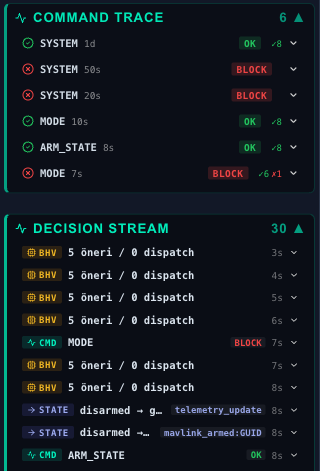
Every command, wherever it comes from, passes through a single decision core before it reaches the aircraft. A state machine asks whether it is possible right now. Nine policies weigh it in a fixed order, safety first. An arbitrator decides whose turn it is. Every decision is written down with its reasons. There is exactly one path to the motors.
- 100Safety
- 90Flight state
- 88System health
- 85Position confidence
- 80Source priority
- 70Battery
- 60Altitude
- 50Velocity
- 40Geofence
- ⟡Arbitrator
- ↓One link to the flight controller
Try the rule
The aircraft’s obstacle behaviour has just ordered a hold. You are the operator.
Holding. Autonomy has the aircraft.
This is the real rule in drone_stack, with its own tests. It was not always so: an earlier version let a safety hold lock the operator out. Simulation found it; this rule closed it. The animation is an illustration.
Seeing
Unknown is not empty.
Flaryx keeps a map of the space around it in three kinds of cell: free, occupied, and not yet seen. A cell the sensor has not looked at is never treated as open air. To explore, it heads for the edge between known and unknown, and the edge moves as it goes.
It stops for what is in its path, not for what is behind it. It remembers an obstacle after it has passed. If the operator’s link drops, it holds, then brings itself home.
- Free
- Occupied
- Not yet seen
Illustration of behaviours that are coded and tested in simulation.
Honesty
It does not take its own word for it.
Early on, the software reported “airborne” as soon as the flight controller acknowledged the command, whether or not anything had moved. Now a command only counts as done when the flight data shows it happened. Every scenario is checked twice: by what the core says, and by what the telemetry shows.
- Said
- Measured
Found in simulation, fixed before any flight
- An exploring behaviour that would have sent the aircraft to latitude 0, longitude 0.
- A safety hold the operator could not override.
- Fixed waits before take-off, replaced by the flight controller’s own readiness signal.
What works today
Real software. Simulated sky.
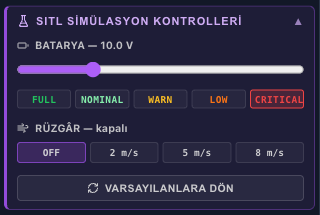
Everything on this page runs today as software: the decision core, the behaviours, mission planning, safety policy and a live operator dashboard, flying against ArduPilot’s software-in-the-loop simulator. It is built to run on a Raspberry Pi 5 with an AI accelerator, talking MAVLink to a standard flight controller. Next comes the first airframe.
Scenarios in the project’s simulation catalog, checked by the core and by telemetry
copter-takeoff-landTakes off and landscopter-rtl-from-altitudeReturns home from altitudecopter-battery-low-triggers-rtlComes home when the battery runs lowcopter-link-drop-triggers-rtlComes home when the link dropscopter-obstacle-avoidance-syntheticStops for an obstacle aheadcopter-obstacle-behind-no-holdDoes not stop for one behindcopter-obstacle-cleared-drone-resumesCarries on when the path clearscopter-multi-obstacle-correct-pickReacts to the right one of several obstaclescopter-concurrent-intent-stressHolds together under many commands at oncecopter-mission-cycle-stressFlies a mission again and againcopter-world-grid-vacuum-mappingKeeps the obstacles it has mapped
Where it points
First, a room.
The first aim is small and indoors: an aircraft that enters a space, maps it without touching anything, remembers it the next time, goes where it is asked, and keeps itself safe when the link drops. Think of a robot vacuum that flies. After that: following what it is asked to follow, at a safe distance. Then, outdoors.
Neron already runs itself on many AI systems working as one. Flaryx is the same idea with a body, and the place Neron’s long-term ambition points.
A direction, not a promise.
Experiment stage
Let’s talk.
Flaryx is early, which is when it can still be shaped. We would like to hear from investors who think in long horizons, and from partners in hardware, research and pilot projects.
hello@withneron.com